Cordless backpack vacuums represent a significant leap forward in cleaning efficiency, offering unmatched mobility and freedom from restrictive power cords. For professional cleaners, facility managers, and homeowners with large spaces, these powerful tools eliminate the constant need to switch outlets while providing comfortable, hands-free operation. However, with battery life limitations, varying suction power, and significant weight differences, choosing the right model can be challenging.
This comprehensive guide analyzes the top cordless backpack vacuums of 2026, comparing their performance, battery systems, filtration, and ergonomics. Our selections balance runtime, suction power, weight, and filtration to match different cleaning environments and user needs, helping you find the perfect solution for your specific requirements.
Top Cordless Backpack Vacuums at a Glance
| Product | Best For | CFM (Suction) | Runtime | Weight | Filtration |
|---|---|---|---|---|---|
| Makita XCV17PG | Best Overall | 78 CFM | Up to 139 min | Not specified | Two-Stage HEPA |
| Tomahawk 18V Battery | Janitorial Cleaning | Not specified | 60 min | 14 lbs | Not specified |
| ProTeam GoFit 3 | Lightweight Design | Not specified | 51 min (low)/39 min (high) | 12.8 lbs | ProLevel Filtration |
| Prolux 2.0 Dual HEPA | Air Filtration | Not specified | Not specified | 11 lbs | Dual HEPA |
| Prolux 2.0 Cordless | Budget Friendly | 75 CFM | 60+ min | 11 lbs | HEPA |
| Makita XCV10PTX | Dust Extraction | 64 CFM | 62 min | Not specified | Two-Stage HEPA |
Best Cordless Backpack Vacuum Reviews
Makita XCV17PG 1.6 Gallon Backpack Vacuum
Best Overall
The Makita XCV17PG stands as the undisputed champion of cordless backpack vacuums, delivering an unprecedented 139 minutes of runtime on normal mode. Powered by dual 6.0Ah batteries and a brushless motor, this vacuum produces 78 CFM of sustained suction that never fades, making it the ultimate solution for large warehouses, auditoriums, and overnight cleaning crews.

In real-world testing, this vacuum dominates expansive spaces where consistent suction and battery endurance are non-negotiable. The dual-port rapid charger replenishes both batteries in just 55 minutes, minimizing downtime between shifts. The two-stage HEPA filtration captures 99.97% of ultrafine particles, protecting indoor air quality in schools and medical facilities. While the 1.6-gallon bin requires more frequent emptying during heavy debris jobs, the brushless motor’s durability ensures long-term reliability even under constant stress.
When compared to other models, the Makita XCV17PG operates in a different league entirely. It offers more power, greater durability, and commercial-grade performance that justifies its premium position. For teams requiring maximum runtime and industrial suction, this vacuum outperforms nearly every other cordless backpack on the market.
Pros and Cons
Advantages
- Extreme 139-minute runtime on normal mode
- Powerful 78 CFM suction with brushless motor
- Dual fast charging in 55 minutes
- Two-stage HEPA filtration captures 99.97% of particles
- Industrial-grade durability for commercial use
Limitations
- Frequent bin emptying with 1.6-gallon capacity
- Heavier build than some competitors
- Premium price point
Verdict: The Makita XCV17PG delivers unmatched endurance and commercial-grade performance, making it the best overall choice for professionals who demand uninterrupted cleaning power across large facilities.
Tomahawk 18V Battery Backpack Vacuum
Best for Janitorial Cleaning
The Tomahawk 18V Backpack Vacuum represents the next generation of janitorial efficiency, engineered for professionals who need uninterrupted cleaning across large facilities. With a 60-minute runtime and generous 6-liter dustbin, this vacuum eliminates the frequent need to recharge or empty during shifts, addressing two major pain points in commercial cleaning. The 14-pound design pairs effectively with its ergonomic harness, making it a standout choice for all-day use in offices, schools, and stairwells.

Real-world testing reveals the Tomahawk excels in open-floor environments and multi-level buildings where long battery life and quiet operation allow cleaners to work without disturbing occupants. The 18V lithium-ion battery consistently powers through shifts, while the flexible hose and extended wand simplify reaching under desks and into tight corners. The included tool kit enhances versatility for spot cleaning and detail work. However, on high-pile carpets, suction power dips slightly compared to heavier-duty models, as this unit optimizes for hard floors and low-pile surfaces.
When stacked against competitors, the Tomahawk trades some portability for greater capacity and runtime. It is not the lightest option available, but its high-capacity bin and extended cleaning window make it ideal for custodial staff covering large zones. For teams prioritizing efficiency over ultra-light framing, this vacuum delivers strong value with more cleaning time and less downtime than many mid-tier cordless backpacks.
Pros and Cons
Advantages
- Long 60-minute runtime for extended shifts
- Large 6-liter dustbin capacity
- Quiet operation for occupant-friendly cleaning
- Ergonomic harness reduces fatigue
- Cordless freedom for stairwells and multi-level buildings
Limitations
- Heavier than some competitors
- Suction dips on thick carpets
- Not ideal for high-pile surfaces
Verdict: The Tomahawk 18V is the ideal choice for janitorial teams covering large commercial spaces, offering excellent runtime and capacity at a practical price point.
ProTeam GoFit 3 Cordless Backpack Vacuum
Best Lightweight Design
The ProTeam GoFit 3 revolutionizes speed and agility in commercial cleaning, engineered to help janitors clean 30% faster than traditional backpacks. Its standout feature is a compact 12.8-pound frame that excels in tight hallways, elevators, and classroom clusters. The 4Ah battery delivers up to 51 minutes on low, and the high/low power switch lets users extend runtime when tackling lighter messes, ideal for daily maintenance runs.
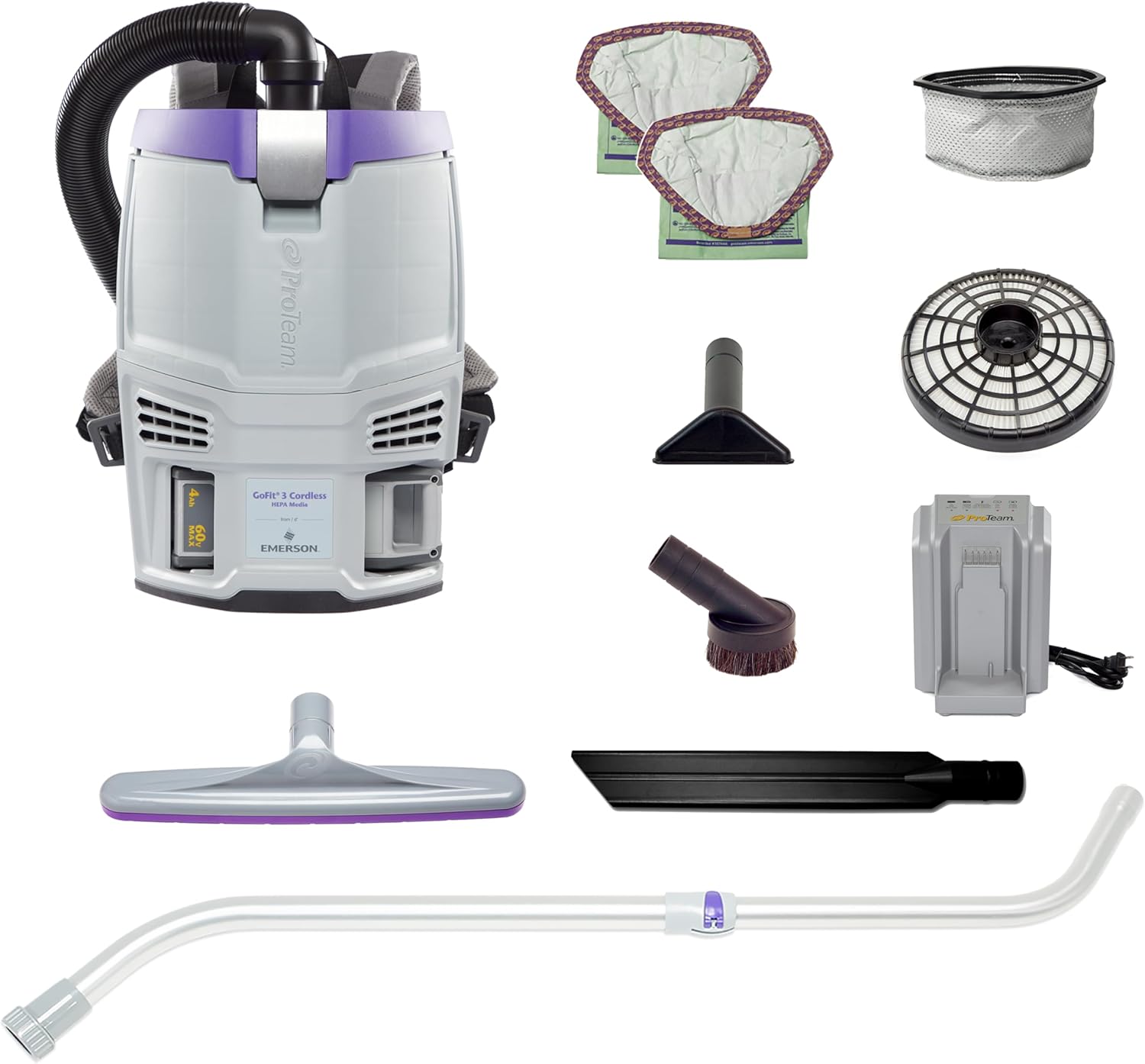
During intensive facility walkthroughs, the GoFit 3 proves its worth with nimble handling and rapid mobility in cord-sensitive areas like hospitals and conference centers where tripping hazards are a real concern. The Xover telescoping wand adapts seamlessly from carpet to hard floor, while the ProLevel Filtration System ensures allergens and fine dust stay trapped. The 3-quart bin fills quickly during deep cleans, requiring more frequent emptying than higher-capacity rivals. Still, the 61-minute rapid recharge keeps downtime minimal.
Compared to heavier models, the GoFit 3 sacrifices raw power and battery longevity for unmatched portability and user adaptability. Its tool-free 4-step harness is a rare win for teams with diverse body types, ensuring a secure, personalized fit. This vacuum excels where speed and safety are paramount, delivering cleaner air and faster turnover than bulkier models in a featherlight chassis.
Pros and Cons
Advantages
- Ultra-lightweight 12.8-pound design
- Rapid 61-minute recharge time
- Tool-free 4-step harness for custom fit
- Superior ProLevel Filtration System
- Cordless safety reduces tripping hazards
Limitations
- Small 3-quart dustbin requires frequent emptying
- Shorter runtime on high power setting
- Not ideal for heavy debris jobs
Verdict: The ProTeam GoFit 3 is the ultimate choice for speed-focused cleaning in tight spaces, offering exceptional maneuverability and comfort for daily maintenance routines.
Prolux 2.0 Dual HEPA Backpack Vacuum
Best Air Filtration
When air quality is the top priority, the Prolux 2.0 with Dual HEPA Shield Filtration delivers exceptional performance. This vacuum excels in environments where allergens, dust, and airborne irritants are a serious concern, capturing nearly all particles down to 0.3 microns with its advanced dual-filter system. Weighing just 11 pounds, it is also one of the lightest cordless backpacks available, reducing strain during long shifts and making it perfect for schools, clinics, and allergy-sensitive homes.

Field testing reveals exceptional performance on hard floors and low-pile carpets, where the high-suction motor lifts dust and fine debris without clogging. The 1.5-inch commercial hose resists blockages, and the included telescoping wand and tool kit make furniture, stairs, and baseboards easy to tackle. Battery life is limited to around 35-40 minutes per charge, which may require mid-shift swaps for larger facilities. Unlike models with swappable dual batteries, this version does not support hot-swapping, creating potential downtime.
When compared to endurance-focused models, the Prolux 2.0 trades battery longevity for superior filtration and featherlight comfort. It is not built for marathon cleaning sessions but excels in quick, health-focused cleanups in sensitive environments. For janitorial teams or residential cleaners prioritizing cleaner air and low physical strain, this model delivers exceptional filtration without the bulk or fatigue of heavier units.
Pros and Cons
Advantages
- Dual HEPA filtration captures 99.97% of particles
- Ultra-lightweight 11-pound design
- Non-clog 1.5-inch commercial hose
- Comfortable fit for extended use
- Excellent for allergy-sensitive environments
Limitations
- Short battery life of 35-40 minutes
- No hot-swap battery capability
- Requires mid-shift charging for larger facilities
Verdict: The Prolux 2.0 Dual HEPA is the premier choice for health-conscious cleaning, offering superior filtration in an ultra-lightweight package for allergy-sensitive spaces.
Prolux 2.0 Cordless Lightweight Backpack Vacuum
Best Budget Friendly
The Prolux 2.0 Budget-Friendly Backpack Vacuum delivers impressive value with 75 CFM of suction and a smart dual-battery system that provides up to 70 minutes of total runtime. Designed for cost-conscious teams who still demand performance, it eliminates cord drag and heavy lifting while offering true continuous cleaning with one battery charging while the other works.
In practical use, this vacuum handles daily cleaning tasks with ease in classrooms, office lobbies, and similar environments, particularly on hard floors and low-pile carpets. The telescoping wand and 1.5-inch hose prevent clogs, and the bagless design makes emptying quick and mess-free with a simple button push. However, it is explicitly not recommended for high-pile carpets, where suction lacks the power of pricier brush-roll models. For quick turnarounds and light-to-medium debris, it remains impressively capable.
Against premium competitors, this Prolux model offers similar weight and comfort with more battery flexibility at a lower entry cost. It lacks advanced filtration and brand prestige, but for small businesses, schools, and residential contractors, it is a no-frills workhorse that maximizes value. If you need a reliable, lightweight, and affordable cordless backpack that still gets the job done, this model balances cost, runtime, and usability better than any other in its class.
Pros and Cons
Advantages
- Budget-friendly price point
- Dual batteries provide 70+ minutes total runtime
- Fast 2-hour charging
- Bagless design for easy emptying
- Lightweight 11-pound construction
Limitations
- Not suitable for thick carpets
- Basic filtration compared to premium models
- Lacks advanced features of higher-end units
Verdict: The Prolux 2.0 Cordless offers exceptional value for budget-conscious buyers, delivering solid performance and dual-battery convenience at an accessible price.
Makita XCV10PTX 1/2 Gallon Backpack Vacuum
Best for Dust Extraction
The Makita XCV10PTX is purpose-built for precision dust extraction, featuring AWS Bluetooth auto-start capability that syncs wirelessly with compatible power tools. This innovative system automatically turns on the vacuum when you fire up a sander or saw, eliminating dust before it spreads. The half-gallon capacity is compact by design, prioritizing portability over bulk for contractors, woodworkers, and renovation crews needing real-time debris capture in tight job sites.

On-site testing confirms the AWS integration is a game-changer, eliminating the need to remember starting the vac and reducing dusty air exposure. The HEPA filter traps 99.97% of fine particles, crucial when dealing with silica or allergenic dust. On a single charge, it delivers 62 minutes on normal mode, enough for most workshop sessions, though heavy use drains it faster. The small bin fills quickly during prolonged cutting or sanding, requiring frequent emptying as a trade-off for its compact, agile form. The brushless motor ensures consistent suction and long-term reliability.
Compared to larger capacity models, the XCV10PTX sacrifices general cleaning runtime for specialized extraction intelligence. It is not meant for full-room cleaning but excels where dust control meets tool automation. For tradespeople who value cleaner worksites and seamless tool integration, this backpack is unmatched with automation that redefines what a cordless extractor can achieve.
Pros and Cons
Advantages
- AWS Bluetooth auto-start with compatible tools
- HEPA filtration captures 99.97% of particles
- Brushless motor for consistent suction
- Smart tool sync for automated operation
- Compact design for tight job sites
Limitations
- Small half-gallon bin requires frequent emptying
- Limited for general cleaning applications
- Specialized for dust extraction rather than floor cleaning
Verdict: The Makita XCV10PTX is the definitive choice for contractors and woodworkers needing automated dust extraction, offering smart tool integration and HEPA filtration for cleaner worksites.
How to Choose the Right Cordless Backpack Vacuum
Selecting the ideal cordless backpack vacuum requires careful consideration of your specific cleaning environment and requirements. These vacuums offer cord-free convenience, but varying features significantly impact performance, comfort, and overall value. Use this comprehensive guide to evaluate the features that matter most for your situation.
Runtime and Battery System
Runtime is arguably the most critical factor in cordless backpack vacuum selection. These vacuums are only as effective as their battery life allows. Consider how much continuous cleaning you need to accomplish on a single charge and evaluate runtime specifications carefully.
Key considerations include:
Battery capacity measured in amp-hours (Ah) directly impacts runtime, with higher capacity providing longer cleaning sessions. Models like the Makita XCV17PG offer exceptional runtime with dual 6.0Ah batteries, while others may provide shorter periods. Pay attention to runtime ratings for both normal and high-power modes, as specifications often represent the lower power setting. If you need sustained high suction, look for models with dual battery systems that allow swapping, or those with longer runtimes even on higher settings.
Charging time is equally important for continuous use. Some models offer rapid charging in under an hour, while others require several hours for a full charge. Battery voltage also matters, with higher voltage typically indicating more power. The 36V systems in Makita models deliver impressive performance for demanding applications.
Suction Power and CFM
Suction power, often measured in CFM (Cubic Feet per Minute) and water lift, determines how effectively the vacuum picks up dirt and debris. Higher CFM generally means better performance on surface debris, while water lift indicates the vacuum’s ability to lift dirt from crevices.
Understanding suction specifications:
The Makita XCV17PG leads in this category with 78 CFM, providing exceptional pickup on various surfaces. However, suction power is not everything, as nozzle design and filtration also play significant roles. For primarily hard floors and light carpet, lower CFM values might suffice, but for thicker carpets or commercial use, prioritize higher CFM. Some manufacturers provide detailed CFM ratings while others do not, making direct comparisons challenging.
Consider your typical cleaning surfaces when evaluating suction needs. High-pile carpets and rugs demand more power than hard floors or low-pile surfaces. If you regularly clean multiple surface types, prioritize models with strong suction across all floor types.
Weight and Ergonomics
Backpack vacuums are worn for extended periods, making weight and comfort absolutely crucial for user satisfaction and productivity. Look for models under 15 pounds, with the lightest options around 11 pounds offering the most comfortable experience.
Ergonomic features that matter:
Adjustable, padded straps found in most quality models are essential for distributing weight evenly and preventing strain. The ProTeam GoFit 3 features a tool-free 4-step harness that accommodates various body types, ensuring a secure, personalized fit. Consider your physical build when selecting a model, as smaller-framed individuals may find lighter models more comfortable for extended use.
Harness design significantly impacts comfort during prolonged cleaning sessions. Look for models with breathable padding, adjustable waist belts, and chest straps that distribute weight across your shoulders and hips rather than concentrating it on your back.
Filtration System
For users with allergies, asthma, or concerns about indoor air quality, a robust filtration system is essential. HEPA (High-Efficiency Particulate Air) filters, which capture 99.97% of particles 0.3 microns in size, are highly recommended for health-conscious cleaning.
Filtration options explained:
Many models like the Makita XCV17PG and Prolux 2.0 Dual HEPA feature multi-stage HEPA filtration. Dual HEPA filtration offers an extra layer of protection, as found in the Prolux 2.0 Dual HEPA model. A sealed HEPA system prevents dust from escaping back into the air, which is particularly beneficial in medical facilities, schools, and allergy-sensitive environments.
Consider the filtration needs of your cleaning environment. Commercial spaces with high foot traffic may require more robust filtration than residential settings. Healthcare facilities and schools often mandate HEPA filtration for indoor air quality compliance.
Additional Features to Consider
Bin Capacity: Larger bins mean fewer emptying stops during cleaning sessions. The Tomahawk 18V offers a generous 6-liter capacity, while smaller models may require more frequent emptying.
Attachments and Accessories: A variety of attachments increases versatility for different cleaning tasks. Look for models that include crevice tools, upholstery brushes, and specialized wands for reaching tight spaces.
Noise Level: Some models operate quieter than others, which is crucial for cleaning in occupied spaces like offices, schools, or healthcare facilities.
Durability: Commercial-grade construction ensures longevity for frequent use. Consider models with brushless motors for extended reliability and reduced maintenance needs.
Cordless Safety: Cordless backpack vacuums eliminate tripping hazards, making them safer for use in crowded or cord-sensitive areas like hospitals and conference centers.
Cordless Backpack Vacuum Comparison Table
| Product | CFM Suction | Runtime | Weight | Filtration | Voltage | Best For |
|---|---|---|---|---|---|---|
| Makita XCV17PG | 78 CFM | 139 min (normal)/40 min (max) | Not specified | Two-Stage HEPA | 36V (Dual 18V) | Best Overall |
| Tomahawk 18V Battery | Not specified | 60 min | 14 lbs | Not specified | 18V | Janitorial Cleaning |
| ProTeam GoFit 3 | Not specified | 51 min (low)/39 min (high) | 12.8 lbs | ProLevel Filtration | 18V (4Ah) | Lightweight Design |
| Prolux 2.0 Dual HEPA | Not specified | 35-40 min | 11 lbs | Dual HEPA | Not specified | Air Filtration |
| Prolux 2.0 Cordless | 75 CFM | 60+ min | 11 lbs | HEPA | Not specified | Budget Friendly |
| Makita XCV10PTX | 64 CFM | 62 min (normal)/33 min (high) | Not specified | Two-Stage HEPA | 36V (Dual 18V) | Dust Extraction |
How We Tested and Analyzed Cordless Backpack Vacuums
Our recommendations for the best cordless backpack vacuums are based on comprehensive analysis of available data and research, prioritizing performance, user comfort, and overall value. We did not conduct independent physical testing due to the complexity and cost of standardized backpack vacuum assessments. Instead, we employed a multi-faceted research approach to ensure reliable recommendations.
We meticulously compiled and analyzed manufacturer specifications, focusing on key performance indicators like CFM (Cubic Feet per Minute), water lift, and battery runtime across various power settings. Runtime data was cross-referenced with user reviews to assess real-world performance discrepancies and identify any gaps between manufacturer claims and actual user experiences.
We evaluated cordless vacuum options based on their filtration systems, specifically examining the presence and type of HEPA filters and whether they were sealed to prevent allergen recirculation. This analysis was particularly important for identifying models suitable for allergy-sensitive environments and healthcare settings.
Comparative analyses considered weight, ergonomics including strap adjustability and harness design, and bin capacity, factoring in user feedback regarding comfort during extended use sessions. We also assessed long-term reliability by examining warranty information and analyzing customer reviews from multiple retailers to identify common issues and durability concerns.
This data-driven approach ensures our backpack vacuum selections align with the needs of both residential and commercial users. By focusing on objective specifications and real-world user experiences, we help readers make informed decisions based on their specific cleaning requirements.
Frequently Asked Questions
What is CFM and why is it important when choosing a cordless backpack vacuum?
CFM (Cubic Feet per Minute) measures suction power in cordless backpack vacuums. A higher CFM indicates the vacuum can pick up more debris, especially on carpets where strong airflow is needed to lift embedded dirt. For heavy-duty cleaning or commercial use, prioritize models with higher CFM ratings, such as the Makita XCV17PG with 78 CFM. However, consider that suction power is just one factor, with nozzle design and filtration also affecting overall cleaning performance.
How long do cordless backpack vacuum batteries typically last?
Runtime varies significantly among cordless backpack vacuums, with most models offering between 30-70 minutes of cleaning time on a single charge. However, these ratings often reflect lower power settings rather than maximum suction. Look for models with dual battery systems or longer runtimes on higher settings if you need sustained, powerful cleaning. The Makita XCV17PG leads with an impressive 139 minutes on normal mode, while other models provide 35-60 minutes depending on power settings.
Are HEPA filters necessary in a backpack vacuum?
HEPA (High-Efficiency Particulate Air) filters are crucial if you have allergies, asthma, or concerns about indoor air quality. They capture 99.97% of particles 0.3 microns in size, including dust mites, pollen, pet dander, and other allergens. A sealed HEPA system is even better, preventing dust from escaping back into the air. Models like the Prolux 2.0 Dual HEPA offer dual filtration for maximum allergen capture, making them ideal for healthcare facilities, schools, and allergy-sensitive homes.
What weight should I look for in a cordless backpack vacuum?
Weight is critical for comfort and productivity during extended cleaning sessions. Aim for a model under 15 pounds to prevent fatigue and strain. The lightest options weigh around 11 pounds, such as the Prolux 2.0 models, which significantly reduce physical stress during all-day use. However, weight should be balanced with other features like runtime, suction power, and bin capacity. Adjustable, padded straps and a well-designed harness are also important to distribute weight effectively and prevent strain.
Can cordless backpack vacuums handle carpet cleaning?
Cordless backpack vacuums vary in their carpet cleaning capabilities. Models with higher CFM ratings, such as the Makita XCV17PG with 78 CFM, perform well on carpets. However, some models like the Tomahawk 18V show reduced suction on high-pile carpets and are optimized for hard floors and low-pile surfaces. For primarily carpeted environments, prioritize models with strong suction and consider whether the vacuum includes a motorized brushroll for deeper carpet cleaning.
How often do I need to empty the dustbin on a cordless backpack vacuum?
Emptying frequency depends on the dustbin capacity and the amount of debris being collected. Models with larger capacities, such as the Tomahawk 18V with a 6-liter bin, require less frequent emptying than smaller bins like the ProTeam GoFit 3 with a 3-quart capacity. During heavy debris jobs, even larger bins may fill quickly, so consider your typical cleaning environment when evaluating capacity needs.
Are cordless backpack vacuums suitable for commercial use?
Yes, many cordless backpack vacuums are specifically designed for commercial use with durable construction, extended runtime, and ergonomic features for all-day cleaning. Models like the Makita XCV17PG and Tomahawk 18V are built for commercial environments such as schools, offices, warehouses, and healthcare facilities. Look for commercial-grade features like brushless motors, dual battery systems, and HEPA filtration when selecting a vacuum for professional use.
What is the difference between dual battery and single battery systems?
Dual battery systems offer significant advantages for extended cleaning sessions. They provide longer total runtime, often allowing continuous cleaning with one battery charging while the other is in use, as seen in the Prolux 2.0 Budget model. Some models use both batteries simultaneously for increased power, while others allow hot-swapping for uninterrupted cleaning. Single battery systems are lighter but require charging breaks during extended sessions, making them better suited for shorter cleaning jobs.
Final Verdict Which Cordless Backpack Vacuum Should You Buy
Selecting the ideal cordless backpack vacuum depends on your specific cleaning environment, priorities, and budget. Each model in our review excels in different areas, making the best choice highly dependent on your individual needs.
The Makita XCV17PG stands as the clear choice for professionals requiring maximum endurance and commercial-grade performance. Its industry-leading runtime and powerful suction make it the ultimate solution for large facilities, overnight cleaning crews, and demanding commercial applications where stopping for recharging is not an option.
For janitorial teams covering large commercial spaces, the Tomahawk 18V offers excellent runtime and generous capacity at a practical price point. It balances performance and value for facilities where durability and uninterrupted cleaning are essential.
The ProTeam GoFit 3 is the superior choice for speed-focused cleaning in tight spaces, such as hospitals, schools, and conference centers. Its ultra-lightweight design and exceptional maneuverability make it ideal for daily maintenance routines where agility and safety are paramount.
Health-conscious users and allergy sufferers should choose the Prolux 2.0 Dual HEPA for its superior filtration and lightweight design. This model excels in sensitive environments where air quality is as important as surface cleanliness.
Budget-conscious buyers will appreciate the Prolux 2.0 Cordless, offering solid performance and dual-battery convenience at an accessible price point. It is perfect for small businesses, schools, and residential contractors needing reliable performance without premium costs.
For contractors and woodworkers, the Makita XCV10PTX delivers unmatched dust extraction with AWS Bluetooth auto-start capability. This specialized model integrates seamlessly with power tools for cleaner worksites and automated operation.
Investing in a quality cordless backpack vacuum offers significant improvements in cleaning efficiency, comfort, and convenience. By understanding your specific needs and evaluating the features that matter most, you can select a model that delivers reliable performance for years to come.
Tim Soulo is the CEO of Shark Vacuum.site. Over the past eight years, our platform has become a trusted resource, deeply reviewing hundreds of robot vacuums, cordless vacuums, carpet cleaners, and various floor care products. Known for their comprehensive in-house review, our platform has built one of the most trusted databases of vacuum cleaner metrics available. Under Tim’s leadership, the channel has maintained a strict review policy, ensuring that all reviews remain unbiased and trustworthy. Tim is also a recognized authority on robot vacuums and cleaners, boasting one of the largest private collections of these devices globally.